

What Is Compliance, and Why Is It Important?
Compliance regulations allow businesses to achieve the bare minimum security threshold for a specific aspect of their business. For example, suppose your business needs to process credit cards and financial information. In that case, it will need a way to protect the customers’ information and prove that it is capable of doing so. PCI DSS (Payment Card Industry Data Security Standard), is a means of accomplishing this. If you follow the PCI DSS set of security standards, that will make you compliant with them, and then you can get certified to prove that. With the certification now obtained, you will be allowed to process credit card and financial information necessary for your business. The same type of logic can be extrapolated to other cloud compliance standards.
Cloud Compliance Basics
Cloud compliance is self-explanatory, it is a set of security standards based within the cloud. Firstly, cloud computing is based on shared responsibility between you and your cloud service provider. What this means is that your CSP is responsible for the security of the platform which you are using, while you on the other hand, are responsible for the end-users. This means that if a breach or a leak happens because you haven’t taken the necessary precautions, your CSP will not be held responsible, and you are expected to take proper security measures on your end instead. There are three different cloud service model types:
- SaaS (Software as a Service) This is a model where the vendor hosts an application in the cloud, which can then be used by a subscriber. In this model, the vendor is responsible for the security, maintenance, and management of the application.
- IaaS (Infrastructure as a Service) In this model, the vendor provides a wide selection of resources. The business is responsible for anything they own or install within this infrastructure.
- PaaS (Platform as a Service) The vendor provides you with the hardware and software that application developers can then use. In this model, the vendor is responsible for the security of the infrastructure and platform.
Note that this is a simplification of the system and that the shared responsibility model is a bit more complex per each type. You do, however, as a customer, always have responsibility for compliance and data security, regardless of model.
Encrypting Your Data
Encryption changes your data into an unreadable format which you can later access only by using your access key. This in turn ensures a very reliable way of securing sensitive data within your cloud. There are a few key things to mention here. If the data is lost or stolen, unauthorized users will be unable to access them.
It is vital to realize that encrypting your data is something you should absolutely be doing. I understand that it is technically considered an extra expense, but the risk of a breach has never been higher. Then also take into consideration that the cost of an average breach is very expensive, costing upwards of a couple of million dollars. This makes it clear that any investment in encryption and enhanced security pays off in the long run, considering that it eliminates a problem before it even happens.
Secondly, by merely encrypting your data, you already meet the requirements of some compliance standards which require you to keep the information confidential. It is also worth noting that in specific cases if you follow specific guidelines, you may even be exempt from disclosing a breach which could save you a whole lot of legal troubles and preserve your reputation.
There are two types of data you should be looking at during encryption, data at rest, and data in transit. Data at rest is stored on the cloud network and does not move. If this data gets stolen or lost, it would be unrecoverable by any malicious actor due to the encryption. Data in transit, however, is usually encrypted using the HTTPS protocol. This protocol adds SSL layers to the standard IP protocol, making it more secure. This way, even if data is intercepted during transmission, it will again be meaningless since you require a digital key to decrypt and access it.
Furthermore, there are two different types of encryption. Symmetric and Asymmetric encryption. Symmetric encryption means that both the encryption and the decryption keys are the same. This allows for simple and fast encryption methods which are best suited for processing large amounts of files. Asymmetric encryption implies that there are two keys, a public, and a private authentication token. These keys are different, but they are linked to one another. This way you can ensure that the person who has the encrypted files, needs multiple factors of authentication to access the files, rather than a single key.
The final thing that needs to be mentioned in this segment is understanding the shared responsibility policy with your CSP. Your CSP will encrypt the platform, but not the contents you put on it yourself, and this is a very important thing to note since it can be a point of confusion at times. The CSP is responsible for the security and encryption of the base that you use to conduct your business, not your business itself, meaning that you will have to encrypt your own files which are on the cloud.
Is There a Way to Automate the Process?
Tools like these allow you to automate many processes and automating regulatory compliance is one of those features. These tools find ways to keep your data safe and secure. They also provide technical support if you ever find yourself in need of it. They are also usually very intuitively visualized, and easy to use out-of-the-box. Furthermore, the tool scans your entire network, making sure that everything is up to code and working properly. This process is also completed in real-time. Here we have a tool that perfectly encapsulates all of these capabilities, streamlines compliance in a quick and comprehensive way, and more.
ManageEngine Log360 Cloud – FREE TRIAL
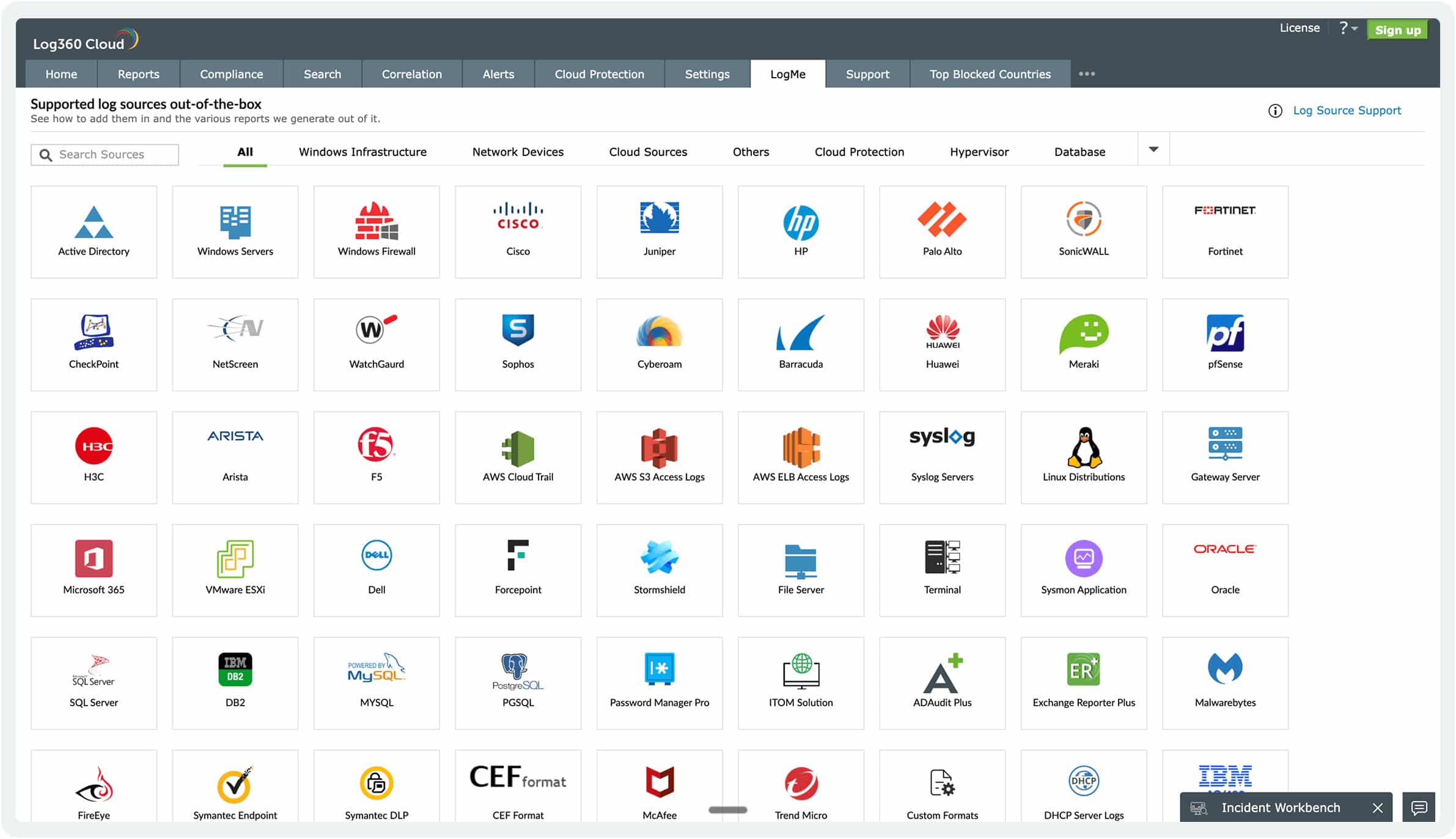
ManageEngine Log360 Cloud is a comprehensive Security Information and Event Management (SIEM) platform that collects logs from different sources, stores them in a central location, and analyzes them for insights. This analysis provides real-time insights into the vulnerabilities and issues in your network, based on which you can take corrective action. The best part is that this tool is cloud-based, so there are no downloads and complex installations, making it a good choice for companies that want to get started right away.
Though Log360 collects logs from different sources, it converts them into a standard format for easy analysis. This feature streamlines the complete log management lifecycle. Moreover, it comes with advanced search and filtering capabilities to help you quickly find what you need. The results of the analysis are displayed on intuitive dashboards that are easy to read and understand.
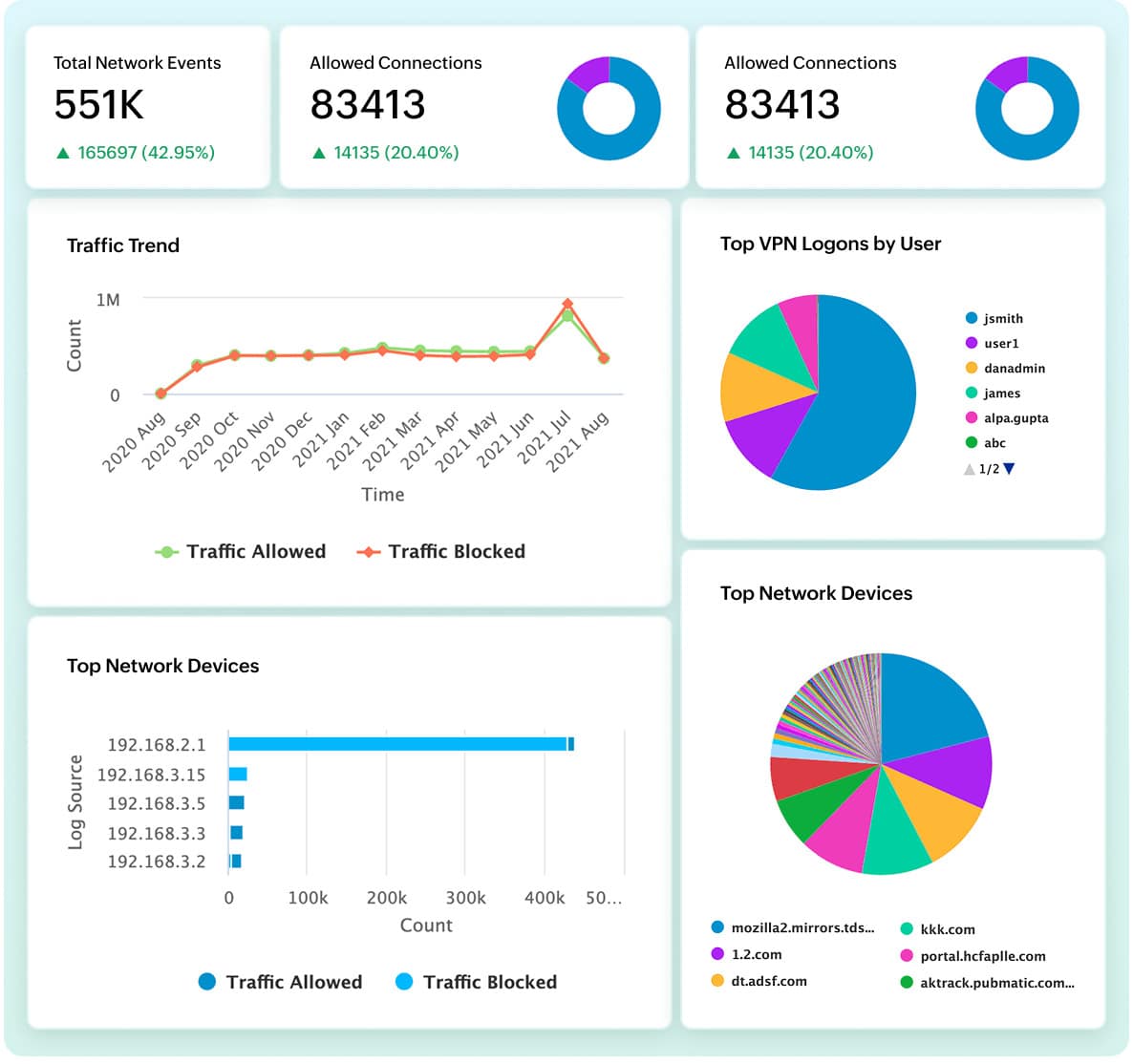
Another notable aspect is its real-time alerts. When the analyzed values deviate from the established thresholds or meet any of the 100+ preconfigured rules, it automatically sends alerts. Its Correlation Rule Builder allows you to build or modify rules through a user-friendly interface.
Furthermore, it comes with an integrated risk scoring feature that identifies high-risk users and entities based on predefined behavioral rules. It also uses machine learning algorithms to identify compromised accounts and data exfiltration attempts.
All these ingiths make it easy for you to detect and fix security vulnerabilities, resulting in improved compliance. Moreover, it comes with pre-built reports for popular compliance frameworks like GDPR and HIPAA, that you can use right out of the box to check your environment for gaps.
Start a 30-day free trial.
Cyscale
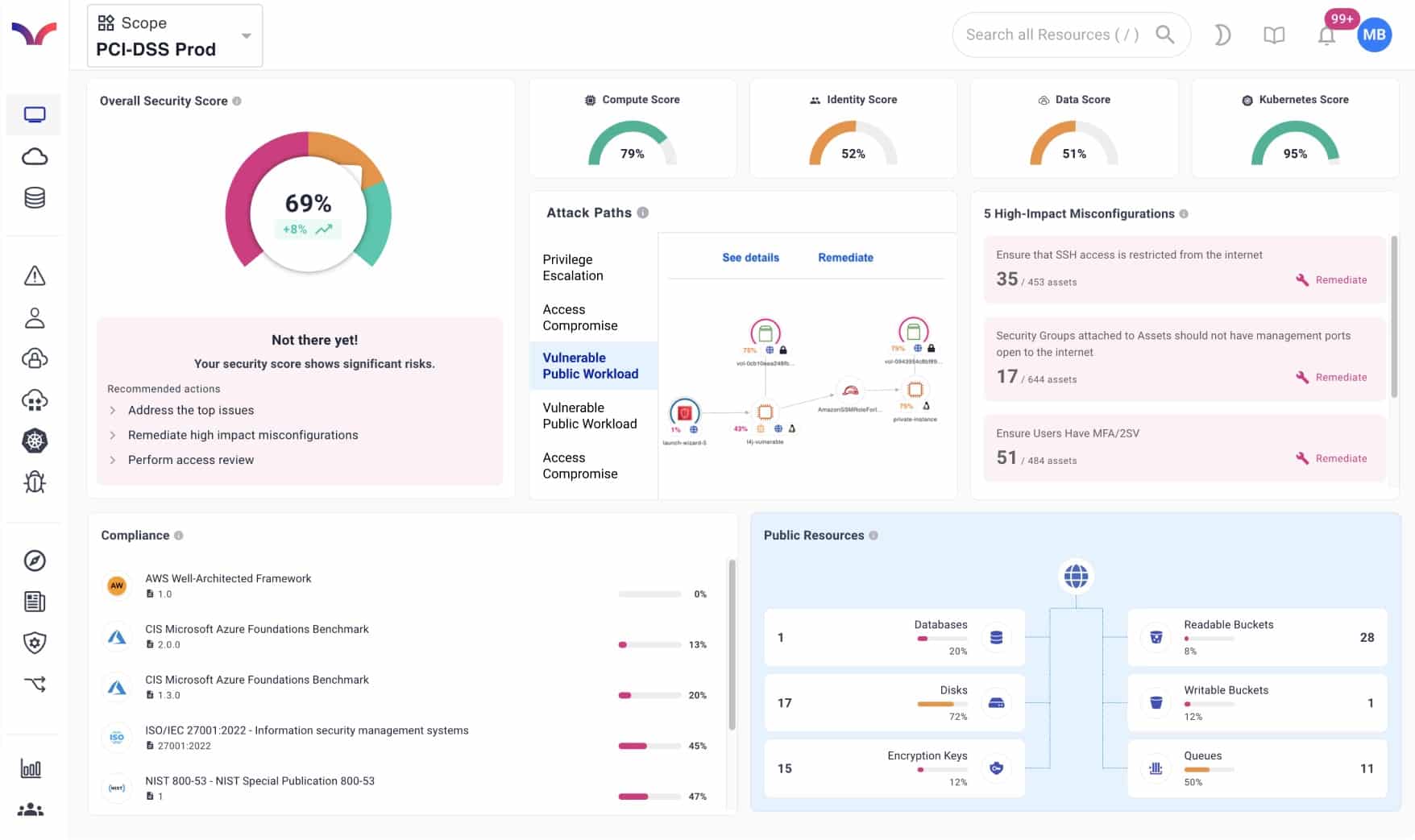
Cyscale is a tool that allows you to automate your cloud security in a variety of different ways. It helps you reduce risks from misconfigurations, identify vulnerabilities, exposed data, improper access control, and many more. It offers you complete visibility for your entire infrastructure under a single, unified view, making sure you are always covered and protected as well as possible while eliminating tool sprawl.
Cyscale also covers your compliance needs from every possible angle. First of all, once you have configured your settings to attain compliance, with any regulatory standard, you are done with it and you can reliably relax and let the tool take over. If you ever drift from the compliance parameters, Cyscale will automatically reconfigure to account for the drift.
Furthermore, it collects data in real-time, allowing you to always be ready for an audit to prove that you are fully compliant with all of the necessary regulations. You can use Cyscale to perform automated evaluations for multiple security frameworks. These security frameworks include ISO 27001, GDPR (General Data Protection Regulation), SOC 2, PCI DSS (Payment Card Industry Data Security Standard), HIPAA, NIST, and many more.
Furthermore, you can get third-party validation for these global security frameworks with the Cyscale Cloud Platform. They keep an auditable data log for one year which contains a multitude of information such as access, identity, changes, operations, and applications and system logs.
Cyscale offers a free 14-day trial which will allow you to get a one-on-one consultation with a cloud security expert, allowing you to better understand your goals and help you get set up, as well as completing the deployment in under 15 minutes. The trial version includes the full features that the paid version of the product would offer. To receive access to the trial version, you will need to contact Cyscale. You can also request a demo if you so wish.
And finally, there are three different paid plans for this product. The Pro, Scale, and Enterprise plans. The Pro version covers up to 1000 assets, the Scale version covers up to 5000 assets, and the Enterprise version is a custom plan. To purchase any of these products, you will have to contact Cyscale directly to get a quote.
Conclusion
We have discussed many important aspects of what constitutes compliance regulations, why it is important to adhere to them, and why your security should be one of your top concerns while running a well-organized business. Mistakes can be costly, far more costly than what you would have to spend to protect yourself from issues that flawed security can create. You be under attack from data breaches, ransomware, or plain employee maliciousness or incompetence. Either way, each one of these problems would be a huge expense and a PR nightmare to recover from, therefore the best solution lies in prevention. We have also covered encryption methods where even if your data does somehow manage to get leaked, you will make sure that the actual contents of the data are unrecoverable. Furthermore, we have discussed a tool that allows you to automate most of these problems in a very short time. This way your technicians will be able to focus on more important things, while security and compliance are safely reliant on the automated processes of the tool for your infrastructure.